Iqra 024
I anticipated a few years ago that with Musk's takeover of Twitter, we will see it collapse into essentially a captured algorithmic ecosystem (an "Everything App") for a nexus of interests from cogwar intel agencies to corporate interest. One only needs to look at the state of the timeline following the recent American adventure in Caracas to see how this has panned out exactly as predicted.
The Alternative Media Complex has now turned into a circus of technodelirium where one is bombarded with 10+ hour streams of lobotomized influencers waging cogwar and pouring acid on the already frayed and weakened epistemic fortitude of the populace.
In light of this, its important to examine the facts, remain above the slop circus and try to determine what really is at stake here. In many ways, one is also reminded how incredibly alike the media ecology of Musk's Alternative Media Complex is to the Legacy Institutional Media Houses that lent their legitimacy and support to Iraq and Afghanistan in the early 2000s. The technological vectors may have changed, but those who are in charge of said vectors and the institutional centre behind it all remains largely unaffected and unchanged.
Let us begin.
Venezuelan Integration in the American Geotechnomic Order
The prevailing dated geopolitical framework remains fixated on the hydrocarbon paradigm (petrodollar imperialism), viewing the Venezuelan crisis through the lens of twentieth-century energy security. This perspective, while not entirely obsolete, is increasingly insufficient for mapping the material realities of the present and indeed the future. The kinetic decapitation of the Venezuelan executive apparatus on January 3, 2026, must be understood not merely as a restoration of democratic order or a seizure of petroleum assets, but as a forcible reintegration of a rogue node into the planetary supply chain of the Stack.
While the spectacle of heavy crude dominates the discourse of the Trump administration—serving as the necessary fiscal collateral for the intervention, the underlying strategic logic is driven by the compute transition. The shift toward electrification, artificial intelligence, and planetary-scale computation has revalorized the geological substrate of the Guiana Shield. The extraction of coltan, nickel, and rare earth elements, along with the capture of the logistical and energetic infrastructure required to process them, represents the true horizon of this conflict.
Oil acts here as the legacy energy substrate upon which the new mineralogical regime is being constructed. The hypothesis that petroleum serves as a distraction is only partially correct; oil provides the immediate metabolic energy for the extraction and transport of the materials required for the fourth industrial revolution.
The Timeline
2016: Legal formalization of the "Crime Frontier" in Bolívar state; 112,000 sq km designated for extraction, initiating massive ecocide and irregular warfare.
2020–2024: Global lithium and nickel prices experience volatility shocks; manufacturers seek to shorten supply chains to the Western Hemisphere. American Megacorps look at coups abroad as a means of navigating through the shocks.
2025: BlackRock's Investment Institute pivots strategy to “Leveraging Up” for AI capital expenditure, signaling a hunger for massive energy inputs.
2025: Global data center investment surpasses upstream oil and gas capex, marking the metabolic shift from combustion to computation.
Jan 4, 2026: Musk activates Starlink over Venezuela, instantaneously privatizing the digital sovereignty of the transition state.
The Orinoco Mining Arc
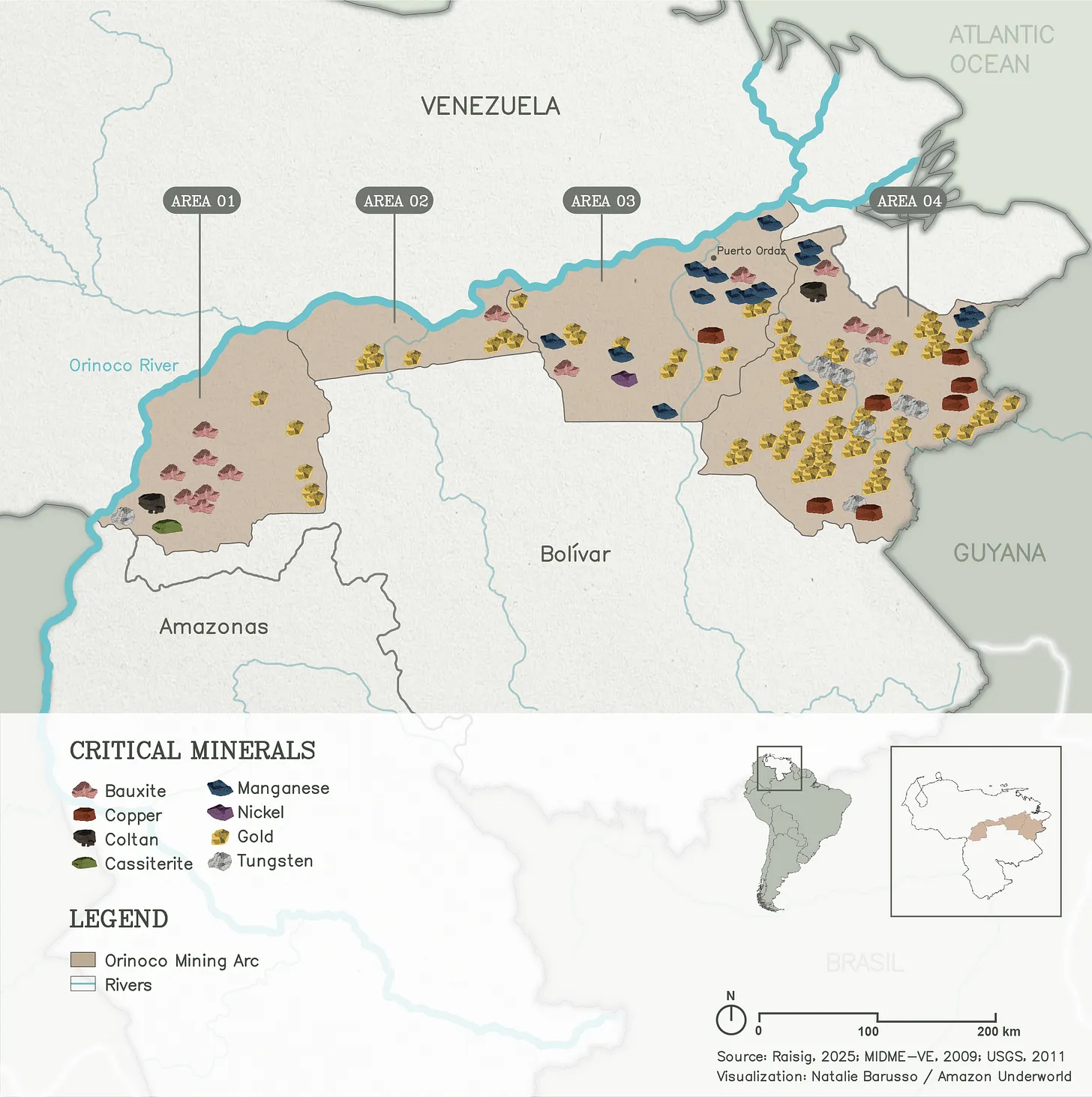
In 2016, Maduro created the Orinoco Mining Arc, roughly 112,000 km² (~12% of national territory) south of the Orinoco River, pitched as a strategic mining zone for gold, diamonds, coltan, nickel, and rare earth elements.
The government’s own claims for the Arc are enormous—gold in the thousands of tons and sizable volumes of coltan/nickel—though verification is thin and the political economy is brutal.
The state narrative posits a clean, sovereign mining district containing over 8,000 tons of gold and vast reserves of strategic minerals. However, the material reality of the Arc is characterized by fragmented sovereignty. The region functions not as a coherent state project but as a zone of indistinct command, where the extraction layer is managed by a patchwork of irregular armed groups—ELN guerrillas, FARC dissidents, and criminal syndicates—operating in a symbiotic yet volatile relationship with corrupt state nodes. One can think of the Egyptian Sinai as a nice analogy for Old Islamicate watchers.
Feasibility and Costs
The integration of Venezuela into the North American "compute stack" faces significant structural friction. The country possesses the upstream raw materials but lacks the midstream industrial capacity to refine them, creating a dependency on external processing hubs, historically located in China. This further adds to one possible scenario that Venezuela may end up being a gray-node, a negotiated shared zone that potentially offers cooperation between competing state-capitalist Megacorps.
The Venezuelan Stack
| Material / Asset | Function in The Stack | Local Reality |
|---|---|---|
| Coltan (Tantalum) | Capacitors for circuitry, avionics, and mobile devices. | Extraction is dominated by irregular armed groups and illicit export routes. |
| Nickel | Cathodes for high-density EV batteries. | The state claims 340 million tons, critical for bypassing Russian/Indonesian supply chains. |
| Rare Earths (REEs) | Permanent magnets for motors and defense systems. | Geological potential is high, but processing capacity is nonexistent, rendering the ore a "stranded asset" without Chinese refining. |
| Digital Infra | Connectivity as a prerequisite for governance. | Musk as loyal GAE-contractor bypasses state telecom monopolies, privatizing the digital interface of the territory. Signals potential to integrate Venezuela and potentially all of Latin America into the GAE Splinternet. |
| Energy (e.g. Guri Dam) | Baseload power for mining and AI data centers. | Opposition leader Machado cites a 17 gigawatt opportunity for "technology and AI," aiming to repurpose stranded hydro capacity. |
GAE Contractor Role
Elon Musk functions here not merely as an industrialist but as an agent of state-patronized platform sovereignty. His infamous 2020 declaration regarding Bolivia should be read as a candid articulation of the supply chain's political economy. Political outcomes in the periphery are treated as flexible inputs for the optimization of production.
His rapid response following the regime's decapitation demonstrates the speed at which platform capital can overlay its own interfacial regime upon a collapsed (collapsing?/dysfunctional) state. This move privatizes the digital territory of the transition, ensuring that the reconstruction occurs within a U.S.-controlled informational architecture. The ideology of the current epoch views the state primarily as a tool for rearranging the material base to serve the imperatives of the technological stack.
State-Megacorp Nexus
The rhetoric of the U.S. security establishment reveals the underlying economic calculus. In 2019, John Bolton explicitly linked American economic interests to the capacity of oil companies to invest in Venezuelan production - Bolton of course is a fossil from a bygone era myopically focused on Big Oil. In 2026, this potentiality has been actualized through military force, with Trump declaring that the U.S. would “run” the country to recoup costs.
The "Plan País," framed as a roadmap for democratic recovery, operates as one potential mechanism for financial enclosure. It transforms the nation's territory into a bundle of assets to be securitized and integrated into global markets. Whilst Trump has no ambitions to court a democratically elected opposition for fear of introducing populist unpredictability in his corpo-technocratic vision for the country, he may still well use the Plan Pais as the basis for a mutual understanding with the new dictator in waiting - a Venezuelan Sisi if you will. This is particularly salient as it seems the Venezuelan establishment essentially handed over Maduro as part of a backroom deal and the military operation was unnecessary theatre for the peasant class back home struggling under a cost of living crisis.
Reports on the extraction of Venezuelan minerals consistently highlight the role of non-state armed actors. The Venezuelan Crime Frontier can be interpreted as a sublayer of the State-Megacorp nexus. The contest is not simply between the U.S. Megacorp and the Venezuelan Praetorian Guard, but between a formalized extraction regime and a networked illicit economy that feeds transnational buyers under the shadow of sanctions.
GAE of course acknowledges the connection between gold extraction and illicit networks. Any transition to "responsible investment" presupposes a capacity for territorial pacification that the incoming administration may struggle to project into the deep interior of the Mining Arc.
Splinternet and Stablecoin Integration
The integration of Venezuela into the American sphere of influence is not limited to the extraction of physical resources; it extends to the total capture of Digital Infra.
This process manifests as Techno-Feudalism, where sovereign functions are outsourced to megacorporate platforms. The activation of Starlink over Venezuelan airspace is the kinetic deployment of this logic: by bypassing the state-controlled ISP, Musk effectively privatizes the nation's connectivity layer, rendering the local "firewall" obsolete not through policy, but through orbital superiority.
Simultaneously, the financial layer could potentially be re-engineered through a Stablecoin Arrangement - a strategy of "monetary regime change". The prototype for this was established during the COVID-19 pandemic, to distribute seized funds directly to healthcare workers, effectively bypassing the Venezuelan Central Bank. The post-Maduro roadmap envisions scaling this model: a "digital dollarization" where USDC or similar programmable assets replace the bolívar, enforcing US monetary policy directly at the retail level without the need for physical cash shipments. The caveat of course is that Circle or Tether are state-permissioned monetary layers and are essentially programmable surveilled layers by the American Intelligence apparatus. In addition, with the expansion of Circle and Tether you create effectively new buyers of American debt at the level of retail consumers.
This aligns with BlackRock’s vision of tokenization as the next evolution of markets. Larry Fink’s assertion that tokenization will drive the next era of global market growth suggests that Venezuela’s distressed assets—its oil reserves, its gold, its real estate—could be the testbed for this financial technology. The "Plan País" thus becomes a mechanism to tokenize sovereign wealth, converting national territory into tradeable digital securities managed by Wall Street custodians, secured by Palantir’s surveillance architecture which is already in play.
Future Scenarios
I envisage broadly speaking three possible different trajectories:
| Scenario | Dynamics | Beneficiaries | Barriers |
|---|---|---|---|
| A) Illicit Continuity | Extraction proceeds via gray-zone networks; processing occurs offshore. Includes China as part of arrangement. | Criminal-political hybrids, external intermediaries. | High friction; difficult to quell and control a disparate patchwork of guerrilla and insurrection groups and criminal syndicate gangs - significant political competence required |
| B) Concession Reset | Transitional government grants large-scale concessions; export becomes "legal" but remains enclave-based. | Western firms (Gold Reserve, Chevron), domestic elites. | Aligns with Plan País and debt restructuring requirements. |
| C) Industrial Policy | Concerted effort to build domestic midstream capacity. | Domestic state apparatus, regional industry. | Low probability; requires convergence of capital and security currently absent domestically and far beyond the capacity of the Americans to provide. |
My personal feeling is that scenario A is most likely - but even that would require significant investment and governance capacity that the American Military simply no longer has the ability to deliver following successive spectacular failures in Iraq and Afghanistan. B and C are a fool's dream. There are many countries with purported large mineral reserves that were under either GAE military occupation or vassalage at one time or another, but the terrain both physically and politically was simply too inhospitable - one thinks of Pakistan's Balochistan region and Afghanistan's reserves which the Americans have spectacularly failed to capitalise on despite having a presence for decades.
There is course a fourth scenario that is increasingly becoming a staple of Trump 2.0 - Padishah simply lacks the attention span and endurance to see this through and will simply drop the whole thing in an ever accelerating cycle of attention economics as statecraft. His team filled with celebrity-inflooncer sycophants like the Hegseths of this world lack the competence and longevity of previous titans of American Empire. There is also of course, the question whether American Megacorps have the appetite to see this through - they have often exited jurisdictions that despite being vassals were simply too volatile.
And God know best